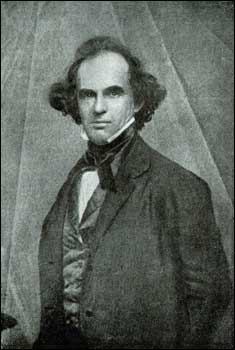
Hawthorne’s personal attitude toward sin and sinners is somewhat ambiguous, despite the existence of a deliberately intrusive narrator in nearly every one of his tales. Some call this issue the “Hawthorne Question”; literary critics want to know what the author of such darkly tragic tales could have thought about the worlds he was creating, but Hawthorne remains a riddle. Did the author sympathize with Hester Prynne? Was his moralizing narration meant to be genuine, or derisively ironic? Was he a Puritan at heart, or did he in fact despise the Puritans? Views on his moral and aesthetic beliefs often contradict one another. One author writes that “many of the central tenets of Transcendentalism (awareness of the creative and imaginative power of nature, the breaking away from form and tradition, and the emphasis on individual experience) can be seen in stories like “Young Goodman Brown” and novels such as The Scarlet Letter” (Felton), while another says “transcendentalism as such touched him not at all” (Canby 231). Advocates of Traditional Historicism, a school of literary criticism that takes social contexts and authorial intent into consideration, would search for answers among Hawthorne’s personal letters, in the politics of his day, and in the friends he made. Supporters of New Criticism would be more likely to take an intrinsic approach and search only between the two covers of an individual tale.
Showing posts with label Essay. Show all posts
Thursday, May 10, 2012
Being True, Part 5: Hawthorne--The Author
This is the last segment of my essay about sin, hypocrisy, and guilt in Nathaniel Hawthorne's writings. Enjoy!
Hawthorne’s personal attitude toward sin and sinners is somewhat ambiguous, despite the existence of a deliberately intrusive narrator in nearly every one of his tales. Some call this issue the “Hawthorne Question”; literary critics want to know what the author of such darkly tragic tales could have thought about the worlds he was creating, but Hawthorne remains a riddle. Did the author sympathize with Hester Prynne? Was his moralizing narration meant to be genuine, or derisively ironic? Was he a Puritan at heart, or did he in fact despise the Puritans? Views on his moral and aesthetic beliefs often contradict one another. One author writes that “many of the central tenets of Transcendentalism (awareness of the creative and imaginative power of nature, the breaking away from form and tradition, and the emphasis on individual experience) can be seen in stories like “Young Goodman Brown” and novels such as The Scarlet Letter” (Felton), while another says “transcendentalism as such touched him not at all” (Canby 231). Advocates of Traditional Historicism, a school of literary criticism that takes social contexts and authorial intent into consideration, would search for answers among Hawthorne’s personal letters, in the politics of his day, and in the friends he made. Supporters of New Criticism would be more likely to take an intrinsic approach and search only between the two covers of an individual tale.
Tuesday, May 8, 2012
Being True, Part 4: The Architecture of Guilt
The fourth part of my essay on sin, guilt, and hypocrisy in Nathaniel Hawthorne's writings. It's more interesting than it sounds ;)

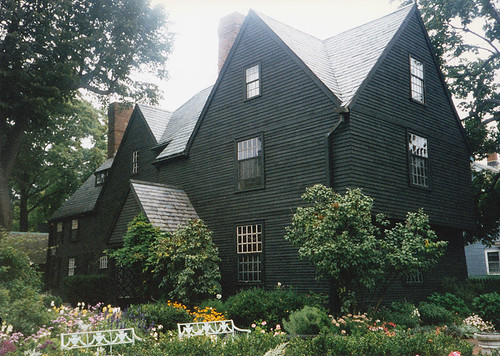
The plot of The House of the Seven Gables focuses on the issue of guilt in both the past and the present. The novel begins with a history of the old Pyncheon family, a clan that is stained with the innocent blood of a man named Matthew Maule, who was executed in the Salem Witch Trials. The family patriarch, Colonel Pyncheon, had zealously cried out for Maule’s condemnation, and in a parallel to the biblical story of Naboth’s vineyard, Maule was killed on false charges and his beautiful piece of property snatched up by that same Colonel Pyncheon. The old Puritan did not have much opportunity to enjoy his ill-gotten gain, however, for Maule had cursed his accuser with the words “God will give him blood to drink,” and Colonel Pyncheon died a mysterious death in his newly built seven-gabled mansion.

To say that Hawthorne’s writing shows a preoccupation with guilt would be an understatement. Most of Hawthorne’s most famous works are permeated with the tragedy of guilt, with a form of the word “guilt” appearing 35 times in The Scarlet Letter, 4 times in “Young Goodman Brown,” and as many as 12 times even in a novel with an uncharacteristically happy ending, The House of the Seven Gables. While some of Hawthorne’s characters choose to embrace sin and others hypocritically deny it, there is a third response: the sensation of guilt or responsibility for sin.
![]() |
| 6233 House of Seven Gables - Salem, MA, a photo by lcm1863 on Flickr. |
Sunday, May 6, 2012
Being True, Part 3: Whited Sepulchers--Hypocrisy
The third part of my essay on sin, guilt, and hypocrisy in Nathaniel Hawthorne's writings...enjoy!


Hawthorne’s writing consistently lifts a light to illuminate our souls, and in several of his stories we are forced to come face to face with hypocrisy—the false pretense of goodness which disguises inner evil. From the religious excesses of the Puritans to the blind optimism of the Transcendentalists, Hawthorne saw hypocrisy all around him. The result of his observations is one of Hawthorne’s darkest and most disturbing tales.
In his short story “Young Goodman Brown,” Hawthorne introduces the reader to the title character, a seemingly harmless young man, and his pretty little wife, Faith, who seems to be an allegory for all that is pure and good. One evening Goodman Brown hurries away to the forest on a mysterious errand, against Faith’s wishes, and we soon learn that he is going to a “Black Mass” in the forest. He has the best of intentions for the future, determining that “after this one night” he would return to Faith and “cling to her skirts and follow her to heaven” (9), but as the night progresses he realizes that evil is more powerful than he had imagined. As he travels along the forest road he discovers that “everyone he has ever respected is actually a vile creature in the service of Hell” (Rogers 4); he even hears the voice of Faith among the sinners, and realizes that virtue is but a dream and “evil is the nature of mankind” (Hawthorne, “Young Goodman” 31). After this terrifying revelation, Goodman Brown and Faith are about to be baptized by the devil when Brown suddenly finds himself alone in the forest in the morning. It is possible that the entire episode was a dream, but Brown’s faith in humanity has been permanently scarred and forever afterward he shrinks away from the hypocrisy of his neighbors. “Young Goodman Brown” could be seen as Hawthorne’s indictment of Puritanical hypocrisy; on the other hand, it might be seen as “everyman’s response to the darkness that lives in every human” (Howard).
![]() |
| gavel , a photo by s_falkow on Flickr. |
Two hypocrites figure prominently in Hawthorne’s fiction.
Wednesday, May 2, 2012
Being True, Part 1: Hawthorne--The Man
I just finished semester 2 out of 4 at Thomas Edison State College! I spent a ton of time writing a final paper for my American Literature I course (it got a grade of 100%!), and thought that I would share it with you lovely readers :)
Perhaps you love Nathaniel Hawthorne, perhaps you loathe him, perhaps you've never heard of him. He was a fascinating man, a great author, and I'm an ardent admirer of his work (read: "big fan"). This paper is rather long, so I'm posting it in several parts. Hopefully you'll read it and gain a new appreciation for the mystery, beauty, and depth of Hawthorne's classic literature!
Nathaniel Hawthorne was an American
author who could be described as a dark romantic, an examiner of the human
soul, a master of Gothic literature, or simply a pessimist. At a time in
history when American writers were discovering their own potential, finding God
in nature, extolling the pioneer spirit, and anticipating a golden age for the
United States, Hawthorne was a voice calling out in the wilderness, reminding
the world of the darker elements beneath it. In his classic novel The Scarlet Letter, Hawthorne
states that the “founders of a new
colony, whatever Utopia of human virtue and happiness they might originally
project, have invariably recognized it among their earliest practical
necessities to allot a portion of the virgin soil as a cemetery, and another
portion as the site of a prison” (Scarlet
Letter 20). Hawthorne seemed to be reminding Americans of something they
would like to forget: sin, like death, is an inevitable part of the human
experience. Hawthorne wrote more than 80 novels and short stories, and many
analyze the legacy of America’s Puritan fathers and delve deeply into
Hawthorne’s own beliefs about sin, hypocrisy, guilt and the truth. Two of his
novels, The Scarlet Letter, and The House of the Seven Gables, as well
as the short story “Young Goodman Brown” deal with these key issues, and by
studying the author and sociohistorical context
of these works, as well as their major themes and intimate details, one
gains a unique perspective on the subjects which weighed upon Hawthorne’s mind.
His consciousness of sin and the need for truth became a major element of
American Gothic literature, and continues to influence authors and readers
today.
Perhaps you love Nathaniel Hawthorne, perhaps you loathe him, perhaps you've never heard of him. He was a fascinating man, a great author, and I'm an ardent admirer of his work (read: "big fan"). This paper is rather long, so I'm posting it in several parts. Hopefully you'll read it and gain a new appreciation for the mystery, beauty, and depth of Hawthorne's classic literature!
Being True: Sin, Guilt, and Hypocrisy in Hawthorne’s Writings
Nathaniel Hawthorne was an American
author who could be described as a dark romantic, an examiner of the human
soul, a master of Gothic literature, or simply a pessimist. At a time in
history when American writers were discovering their own potential, finding God
in nature, extolling the pioneer spirit, and anticipating a golden age for the
United States, Hawthorne was a voice calling out in the wilderness, reminding
the world of the darker elements beneath it. In his classic novel The Scarlet Letter, Hawthorne
states that the “founders of a new
colony, whatever Utopia of human virtue and happiness they might originally
project, have invariably recognized it among their earliest practical
necessities to allot a portion of the virgin soil as a cemetery, and another
portion as the site of a prison” (Scarlet
Letter 20). Hawthorne seemed to be reminding Americans of something they
would like to forget: sin, like death, is an inevitable part of the human
experience. Hawthorne wrote more than 80 novels and short stories, and many
analyze the legacy of America’s Puritan fathers and delve deeply into
Hawthorne’s own beliefs about sin, hypocrisy, guilt and the truth. Two of his
novels, The Scarlet Letter, and The House of the Seven Gables, as well
as the short story “Young Goodman Brown” deal with these key issues, and by
studying the author and sociohistorical context
of these works, as well as their major themes and intimate details, one
gains a unique perspective on the subjects which weighed upon Hawthorne’s mind.
His consciousness of sin and the need for truth became a major element of
American Gothic literature, and continues to influence authors and readers
today.Saturday, January 7, 2012
Our Universal Language: How Poetry Speaks
Ancient Egyptian Literature: who knew that I would ever write on such a topic? College will make you do some interesting things....
Paul Engle, noted American teacher and literary critic,
once called poetry “ordinary language raised to the Nth power. Poetry is boned
with ideas, nerved and blooded with emotions, all held together by the
delicate, tough skin of words.” He obviously thought that poetry is something
special, complex, inexplicable—and he is not alone. The poetic devices of
metaphor, simile, and hyperbole have the power to stimulate our imagination;
poetry’s rhythms can synchronize our breathing and heartbeats; brain research
seems to suggest that poetry is actually a paradox, “…language is a
predominantly sequential activity, of a conspicuously logical character,
typically associated with the left cerebral hemisphere; whereas diffuse
emotional processes are typically associated with the right cerebral
hemisphere…. Accordingly, emotional poetry, or mystic poetry ought to be a
contradiction in terms” (Reuven). But it is not a contradiction. The poetry of
love, for example, may be structured and logical, but also highly emotional,
conveying feelings of longing, disappointment, anxiety, and admiration. Poetry
stretches our minds in ways that few art forms can.
Thoughts and emotions are able to travel through the
medium of poetry to virtually any destination. Verses written thousands of
years ago in China, Israel, or Greece can change the life of a twenty-first
century Guatemalan, and a poem written today may very well influence the fate
of future generations. Ancient Egyptian Poetry, for example, is full of images
and emotions that a modern reader can easily identify with, and is an example
of the “universal language” of poetry. Though inscribed on papyrus thousands of
years ago, these poems are still capable of communicating with us, offering
both knowledge and enjoyment.
Subscribe to:
Posts (Atom)