Showing posts with label Apologetics. Show all posts

Monday, March 19, 2012

Is God Guilty of Murder?

I don’t like this subject.

Christian apologetics is great, especially if it’s on a subject like Creation vs. Evolution, or the Resurrection of Christ, or Transubstantiation,  but when it gets on a subject like the righteousness of God and his judgment things get a bit messy.

A dear cousin of mine recently called me out on a statement I made about the pro-life vs. pro-choice debate. I was arguing that abortion was unjustified according to God’s law, which eventually degenerated into a debate about the consistency of God’s character concerning murder. This went on for dozens of comments back and forth (we were on a Facebook status update when all of this started), until we both had to sit down and seriously formulate some arguments. I think that Facebook is an awful place to carry on a debate, so I decided to reproduce some of my arguments here, on my blog, for clarity. Perhaps some of my readers have input for me, either encouragement or criticism. Whatever anyone has to offer, I would be appreciative of anything that will help sharpen my wits and keep me grounded in the truth.

Friday, July 23, 2010

Jesus: Fact or Fiction, Part 3


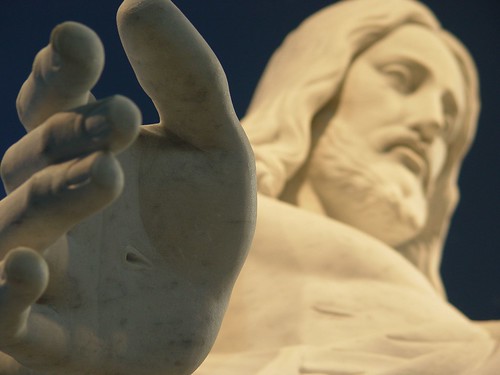
Passion, originally uploaded by gilderic.


The question of Jesus' divinity comes down to this: if the resurrection is false, then he was nothing more than a mortal like you and me. So do the facts back this miracle up?

First of all, Jesus predicted the manner of his death (Mark 10:32-34, Mark 8:31, Matthew 26:1-2). How was he to know that the Jews would go to the Romans and request that he be crucified? Why not stoned? Why not accidentally killed in a donkey accident? He pinpointed the exact manner of his death. Not only that, but David described his death in detail hundreds of years before Jesus was born (Psalm 22)! 


Plus, only a lunatic would make the claim that he would rise from the grave three days after his death. Perhaps 100 years or so after his death, but in three days everyone would know for sure that he was a liar and his legacy would immediately crumble. However, three days later he disappears just as predicted. 


Did Jesus really die on the cross? Absolutely. The blood and water that flowed from his side, minutely described in John 19:34, was likely due to cardiac rupture (info here). Besides, after going through the gruesome, terrible, physically destroying process of crucifixion, even if everyone had been fooled and Jesus was still alive (maybe he swooned?), could any human being survive three days in a tomb without any medical assistance or sustenance? 


Was Jesus' body stolen away by his followers? The Bible speaks of a Roman (or temple) guard being posted at the Jews' request, to prevent just such an eventuality, and the tomb was sealed. After the stone was rolled away and Jesus was missing, the Jews and soldiers began spreading the story that the guards had fallen asleep and then Jesus' disciples had stolen his body away. Here's a quote from Josh McDowell:

...the first obvious fact was the breaking of the seal that stood for the power and authority of the Roman Empire. The consequences of breaking the seal were extremely severe. The FBI and CIA of the Roman Empire were called into action to find the man or men who were responsible. If they were apprehended, it meant automatic execution by crucifixion upside down. People feared the breaking of the seal. Jesus' disciples displayed signs of cowardice when they hid themselves. Peter, one of these disciples, went out and denied Christ three times.
This alone is great evidence for the truth of Jesus' resurrection. That and the little matter of more than five hundred people seeing Jesus before his ascension into Heaven. All of these people could confirm exactly what the apostles said, and if the apostles were lying, there were that many people who could prove them wrong. They didn't.  


But what if it was the disciples who had stolen their teacher from his tomb? What then? We might expect the disciples to begin spreading stories, saying "I told you so", maybe even going out to spread the teachings of their dead master, who they knew very well had not risen from the dead.


But would they die for a dead man?


The death of the Messiah was a theological impossibility for the Jews. If Jesus truly died, he truly was not the Messiah. What disciple, no matter how devoted, would die for something he knew was a lie? Why would he deliberately walk into persecution, become an outcast, face danger every day and go like a sheep to be slaughtered into the enemy's jaws for something he didn't believe? If Jesus died that day in Palestine, once and for all, never to rise, then the disciples' hopes of forgiveness and eternal life were completely in vain. Yet they lived their entire lives as if they had indeed seen their Lord, risen, living, and powerful even after death. They were shocked, awed, amazed, and compelled to spend the rest of their lives telling that story.


I believe in the divinity of Jesus Christ not only because the facts point that way, but because I know of lives that have been changed, even revolutionized, by the power of this God/Man. All of this together, I am convinced, is evidence enough for the existence of the Christian God. 


Wednesday, July 14, 2010

Jesus: Fact or Fiction, Part 2


There is overwhelming evidence for Jesus being an actual historical figure of some kind. He is not a myth altogether, but what reasons have I for believing that he was the Son of God? 

First of all we have to look at what he could have been. What are our options? 

1. He was a lunatic.
2. He was an egomaniacal deceiver.
3. He was the Son of God.
4. He was something great, but not what the Bible makes him out to be.
5. He was a good teacher and nothing more. 

C.S. Lewis is famous for pointing out that the fifth option is not an option at all. He puts his "Trilemma" argument like this:


"A man who was merely a man and said the sort of things Jesus said wouldn't be a great moral teacher. He'd either be a lunatic-on a level with the man who says he's a poached egg-or else he'd be the Devil of Hell. You must make your choice. Either this man was, and is, the Son of God: or else a madman or something worse. You can shut Him up for a fool, you can spit at Him and kill Him as a demon; or you can fall at His feet and call Him Lord and God. But don't let us come with any patronizing nonsense about His being a great human teacher. He hasn't left that open to us. He didn't intend to." 
— C.S. Lewis 

So what exactly did Jesus say about himself according to the Bible? 


From Wikipedia:
There are differing views within Christian groups as to whether or not Jesus ever claimed to be God. The majority of Christians hold that the Bible shows Jesus both as divine, and claiming divinity. Many modern scholars, however, argue that Jesus did not, in fact, make any such claims, either directly or indirectly; John Hick contends that there is general agreement among scholars today that Jesus did not claim to be God: "such evidence as there is has led the historians of the period to conclude, with an impressive degree of unanimity, that Jesus did not claim to be God incarnate,"source
Look at John 10:25-33. 

 Jesus answered, "I did tell you, but you do not believe. The miracles I do in my Father's name speak for me, but you do not believe because you are not my sheep. My sheep listen to my voice; I know them, and they follow me. I give them eternal life, and they shall never perish; no one can snatch them out of my hand. My Father, who has given them to me, is greater than all; no one can snatch them out of my Father's hand. I and the Father are one."  
Again the Jews picked up stones to stone him, but Jesus said to them, "I have shown you many great miracles from the Father. For which of these do you stone me?"  
"We are not stoning you for any of these," replied the Jews, "but for blasphemy, because you, a mere man, claim to be God."

The Jews knew exactly what Jesus meant, and were ready to stone him for it! "I and the Father are one." How plain does it get? How about John 5:17-18. Once again, making himself equal with God. John 8:58. To a Jew this would be a blatant presumption to preexistence and therefore Godlike status. What about Jesus' actions? What did they say about him? Well, we know that he didn't refuse worship (Matthew 8:2, John 9:35-39), unlike his disciples, who tore their clothes when the people of Lystra tried to worship them (Acts 4:8-18).  


So Jesus obviously believed that he was something special. Was he insane? No logical person can read his words, his teachings, study his many friends, his actions, the reactions of his enemies, and conclude that he was crazy. As far as I know, this was never a charge leveled at him by his contemporaries. All of the evidence points to the fact that he didn't act like a crazy person.


Was he a deceiver? Read the sermon on the mount and tell me that that was spoken by an attention-hungry egomaniac. His teachings and actions are full of love, peace, patience, kindness, and holiness. Jesus did not defend himself when on trial for his life. If he was just bluffing to get power and influence, wouldn't he call it quits when standing before Pilate and hearing the words, "Do you not know that I have power to release you, and power to crucify you?" Only a lunatic would have carried on at that stage. 


Perhaps the Muslims are right, and while Jesus was a real man and sent by God, the Bible does not accurately represent his words and actions. Some say that the New Testament has been corrupted. Well, we do not have the actual manuscripts handwritten by Matthew and Mark, so that means that the original meaning may have been changed in copies, right? Wrong. This is from CARM.org:
Our first manuscript copy of the New Testament (John Ryland’s Papyri, dates from 117-138 A.D.) comes about 30-40 years after the original book was written (i.e. the Gospel of John in about 90-95 A.D.).  Also, we actually have over 5,700 Greek New Testament manuscripts!  In addition to all of the Latin, Coptic, Syriac, and other languages, we have about 25,000 total New Testament manuscripts! 
Perhaps the original manuscripts were destroyed and substituted with false documents! Right. Even if someone were somehow able to collect all of the originals and destroy them, they would also have to do away with the writings of the early church fathers, who quoted so extensively from the texts that we could reconstruct all but about 11 verses of the New Testament simply from their writings. Jesus' words were recorded by eyewitnesses. They were not altered by the early church or scribal error to portray a completely different Jesus.


We could go on and on with proofs of Jesus' divinity.


For example: it was prophesied that the Messiah would perform miracles. Jesus performed miracles not only with his supporters, but also before his toughest critics. Far from denying them, his enemies simply tried to explain them away as the evil doings of the devil! In ancient times scholars tried to explain the darkness at the crucifixion by saying it was an eclipse (even though this is scientifically impossible), but they didn't deny it happened. 


Next up:
                      Jesus: Fact or Fiction, Part 3 - The Resurrection

Tata for now,
Abby Rogers


Tuesday, July 6, 2010

3. Jesus: Fact or Fiction? Part 1


We are going to examine Jesus' credentials here. There are several major questions that need answering:


1. Was the Biblical figure of Jesus an actual historical figure?


2. Was he actually the Son of God?


All of our lives hinge on the answers to these two questions.

If Jesus was a phony and all of Christianity is wrong, then we can either look into alternative religions seeking truth, or consign ourselves to godless atheism. If Jesus was not a phony and all of Christianity is right, then we have a major decision to make: will we follow him, or remain at a distance?

To answer the first question:

We have older documentation and earlier eye-witness accounts of Jesus' life than we have for any other religious leader of antiquity. There are many secular accounts of Jesus that confirm his historicity. Reliable sources like Cornelius Tacitus, Lucian of Samosata, Suetonius, Pliny the Younger, Thallus, Phlegon, Mara Bar-Serapion, and others, wrote of a man who claimed to be God and was killed for it. 

Unlike anyone else in history, Jesus fulfilled dozens of prophesies, including the location of His birth, key events of His ministry, and the circumstances of His death, all written centuries before He was born! To quote Josh McDowell "If you are not satisfied with 450 B.C. as the historic date for the completion of the Old Testament, take into consideration the following: The Septuagint--the Greek translation for the Hebrew Scriptures--was initiated in the reign of Ptolemy Philadelphus (285-246 B.C.)." In order to be translated, the scriptures had to be originally written at least 250 years before Jesus' birth!


It was prophesied that Jesus would be
     Born of the race of Abraham
     More specifically Abraham's son Isaac
     More specifically Isaac's son Jacob
     Of the tribe of Judah
     Of the family line of Jesse
     Of the house of David
     Born at Bethlehem
     Presented with gifts
     He would be filled with zeal for God
     His ministry would begin in Galilee
     Perform miracles
     Enter the temple
     Enter Jerusalem on a donkey


There are so many more, that gall and vinegar would be offered to him, that he would commit himself to God, that his bones would not be broken, that he would be pierced (all this on the cross). Could Jesus have engineered all of this himself? Methinks he could hardly have worked out the "born in Bethlehem" part, the manner of his death, or the soldiers' casting lots for his clothes (also specifically prophesied). Coincidence? It is estimated that the chance of one man fulfilling even eight of the prophesies Jesus fulfilled is 1 in 100,000,000,000,000,000. This is like painting a quarter red and then throwing it into a pile so large that it would cover the state of Texas two feet deep, and then asking a blind man to pick out the red quarter.


Come back for the next exciting installment!


Photo by midiman


Thursday, June 24, 2010

2. Why the God of the Christians?


So there is a Mind behind this universe. Traditions and religions around the world bear out the idea that men inherently know that this is true. But who is right? Which religion, which god, is the true one?


The first viewpoint to examine is the one that believes every religion valid. We have to realize, right off the bat, that this is an inherently contradictory belief. It sounds good at first, but with just a little digging we find that a big problem lie beneath the surface. 

If all faiths are true, then Judaism and Christianity are both equally true. But Jews say that Jesus was not the Christ, and Christians say that he was. How can these two opposite beliefs both be correct? How can Hinduism, which has 330,000 "personal gods", be compatible with Islam, which has one God, Allah, and absolutely none other? Look at it logically, it's simply not possible.

All religions cannot be true. There is only one absolute truth.   

So, what is this truth?


From a summary of Ravi Zacharias' book Jesus Among Other Gods, "Our greatest hunger...is for a consummate relationship that combines the physical and the spiritual, that engenders both awe and love, and that is expressed in celebration and commitment." We all feel a longing for God, but at the same time an utter unworthiness. We are separated, alienated, from the God of the universe. We may deny it, but there is a vacuum in our souls and a search for the divine in all of us. However it is a search; we are not born into friendship with God, we are all looking for the way to Him. 


Let's look at what the God of the Christian religion says about this.


Jesus addresses the problem of separation head-on, saying that all have fallen short of God's perfect holiness. No one can live up to their own standard of morality, much less the standard of an all-righteous God! We are not worthy to be His slaves, much less his friends. Our sin is the thing that stands like a vast canyon between us and God's righteousness


"As for you, you were dead in your transgressions and sins...."


But the Christian God didn't just give us more rules to try to make our sinful lives run smoother, instead He did something amazing and completely out of the box - He sent a mediator - absolutely perfect and innocent God, at the same time mortal Man - who could take the penalty for sin upon Himself and thereby give humans a free pardon. He didn't try to make fallen men better, He extended grace.

But because of his great love for us, God, who is rich in mercy, made us alive with Christ even when we were dead in transgressions...For it is by grace you have been saved, through faith—and this not from yourselves, it is the gift of God— not by works, so that no one can boast." 

A mediator was the only one who could properly do the job of reconciliation. There is only one great religious leader who claimed to be the exclusive direct way to God. Christianity is completely based upon this person: Jesus of Nazareth, the Christ.

So here is the next question: was Jesus the real, true God-Man? Come back for the next post-


The Messiah Jesus: Fact or Fiction?


P.S. I got a lot of information from the documentary 
The Case For Faith, so thanks to Lee Strobel!


Originally uploaded by PhillipC

Wednesday, June 16, 2010

1. Is There a God?


To quote from my questioner:


"How are you so sure that there is a god at all? Have you ever thought about this? If so, what are your arguments for the existance of God?" 


First of all, yes, I have thought about this. I have heard that there is a supreme supernatural Being who holds the universe in His hands and Who says that I must answer to Him for everything I say and do. That is a pretty big deal and it demands my attention. I'm not one of those people (I assume they are out there) who drink in everything they're told with unquestioning naiveté and never think to substantiate their deepest held beliefs. But I'll talk about all that later.

So what are my arguments? Well, I have heard and considered many, but here I'll set down what I think is one of the most convincing evidences of the existence of Something that is constant and transcendent (beyond the natural dimension), Something rather like a mind, which is undoubtedly powerful.

We must begin with deciding where to look. If this is an omnipresent Being, then one should be able to look to science, mathematics, language, psychology, metaphysics, astronomy, etc.. But I think that one of the first places we should look is right inside ourselves. If God made us and wanted a personal relationship with us, then wouldn't He have told us of His existence?Wouldn't one of the most likely places be within our own mind and spirit? Atheists and agnostics call for signs in the sky, but I believe that if we were to find definite signs of something beyond humanity within ourselves then that would be pretty hard evidence.

So let's look for that, shall we?


Let's look at an everyday occurrence that sheds light on this subject. When someone takes the place you wanted on a bus, are you angry at them? Well no, not if you're a reasonable person. You realize that they meant no harm by it, so you let it go. But, if you had just stepped off the bus and come back to the place you were sitting, to find your purse moved to another seat and someone sitting in the one you had vacated, you would probably feel entirely different. You might keep your temper, but you couldn't help thinking that  this person had "done you wrong." Why the different reaction? The end result was the same!


First, what is wrong, exactly? From the way people talk and act it looks as if there's some sort of treaty or bargain in place, and it isn't right to break it. We need to be fair, nice, polite, and generous. We are somehow bound to forgive and forget, and to not hurt others for our own pleasure. But why? If you are an atheist, who doesn't believe in moral objectivity, then why do you not approve of the sadistic torturing of babies? Because it doesn't happen to suit you? No!


Upon serious introspection, we find that there are some things that we unequivocally deem right or wrong. upon which there can be no middle ground.


If this is not true in your case, please feel free to leave a comment below. 


So it would seem that there is a kind of standard, truths that are universally acknowledged, that all humans have stamped in their very being. Where did it come from? 


Is it merely instinct? No, because sometimes our instincts are contradictory (the urge to save a drowning man and the urge to save myself). Besides, this law tells us what we ought to do with our instincts and emotions: which ones to encourage and which to suppress (we know that we ought to save the drowning man and that we ought to squash our selfish feelings of self-preservation).


Perhaps this law is just the best system we humans have worked out; it has evolved over the years and turns out to be the best way to preserve ourselves and society. But what about our drowning example? It is a dangerous situation, and may not turn out very well. Why take a chance? Is it better for society that I die instead of the other man? It's even more likely that we will both die in my attempt to save him. Why is that praiseworthy? Because it is right.


There is a Law of Nature, the law of what we humans should do, and in fact are not doing (We've all experienced guilt and regret, why?). Who determined this Law? Certainly not humans. We break it so often, if it were merely our own invention how could it possibly have survived this long?


No, the Law of Nature, like any other law, must have been created - been engineered by something - and that Something being rather more like a mind than anything else (after all, how can you have a creating being that is not like a mind?). It is something beyond humanity, beyond our physical dimension, something powerful, and logical, which has implanted its ideas and opinions in every man and woman who has ever been born.


The existence of human conscience points to a mighty creator.

I will continue posting, elaborating on this and explaining why I believe this supernatural  Being to be, in fact, the specific God of the Christians.

-Abigail Rogers 

Tuesday, June 8, 2010

The Challenge We All Face

A recent comment on one of my old blog posts


Dear Miss Abby Rogers,


How are you so sure that there is a god at all? Have you ever thought about this? If so, what are your arguments for the existance of God? I'm sure your parents have taught you some of these?


How do you explain that there is so much suffering in the world yet God is supposed to be omnibenevolent, omnipotent and omniscient? How do you explain the inconsistencies in the Bible?


Let me know,


Ella De'Ville


This question poses a challenge, a challenge to me and really a challenge to everyone who calls herself a Christian and has never searched deeply into the hows and whys of their faith, instead just taking for granted what she has heard from parents and peers all her life.


Some people might say to "take it all on faith". Let me quote C.S. Lewis in his answer to another idea, "Don't talk such damned nonsense." Our experience is constantly offering up daily proof that an uninformed person is a foolish person, and one who is almost inevitably destined for failure. Forrest Gump is the only one who can succeed in life through blind faith and chance. The rest of us have to do our research, our soul searching, and come up with a reasonable explanation of why our worldview is the best there is. 


Now I'm warning Ella and all others who might have a preconceived notion of apologetics and all related arguments for such concepts as the existence of God. You can't prove any of it with pure pure facts. If someone is convinced of their own rightness or wrongness, no matter how many wonderful arguments are thrown at them they will never listen. I'm not trying to convince anyone, I'll just attempt to synthesize in blog posts the basis of my belief. Incidentally this is actually something that I've been working on for quite some time.


So here I go, jumping into deep water way over my head into subjects that have stumped the most brilliant philosophers for millenia. I won't have all of the answers, by no means, but I intend to testify of and give answers concerning Jesus Christ and my faith in Him.

LinkWithin

Related Posts with Thumbnails