Showing posts with label History. Show all posts

Sunday, April 22, 2012

Islam: Empire of Faith

Empires - Islam: Empire of FaithOver the past few months I have been studying the religion and culture of Islam extensively in college, trying to learn more about a religion that features so prominently in the media and in Christian circles, seeking to understand where Muslims are coming from, and how they can be reached by the gospel. I have been reading Islamic writings, hearing recitations of the Quran, seeing photographs of Muslims and their architecture, but for me nothing has quite synthesized the whole of Islam with such brevity and beauty as the PBS documentary Islam: Empire of Faith. This remarkable film lays out the rich history of Islamic empires from pre-Islamic Arabia to the reign of Suleiman I, depicting Islamic faith and practice as well as society, politics, and economics in a way that words and pictures on a page could not.

The film goes to great pains to depict Islam in a new light, emphasizing points that a typical American may have never known; for example, the history of Muslim toleration for religious dissidents, their massive contributions to science and literature, and their influence on Europe. The screenwriters seemed a bit biased in their portrayal of Islam’s history, often emphasizing the positive elements without addressing the many issues that non-Muslims have with Islam. However, the historical facts that I saw on screen seemed to line up with what I have been studying this semester.
One aspect of the documentary which I found to be especially interesting and challenging was the comparison and contrast of Islam with Christianity. The film is constantly bringing out the sophistication of the Muslim world at the expense of historical Christendom. The impression one gets is that Muslim culture has been economically, scientifically, morally, militarily, agriculturally, and academically superior to anything Western for much of its history. The beauty and enlightenment of the European Renaissance is largely attributed to Muslim scholars and philosophers who sowed the seeds that eventually led to the Scientific Revolution. According to Islam: Empire of Faith, the Crusades actually affected the Europeans far more than the Muslims, as crusaders brought the tastes and traditions Middle Eastern cultures to the West. This is not a perspective that I have often seen, and has challenged me to reevaluate my belief that European culture is so far superior to that of the Middle East.
The New Mosque Istanbul by Stew Dean
The New Mosque Istanbul, a photo by Stew Dean on Flickr.

As a viewing experience, Islam was wonderful—even on a low quality setting on YouTube. The on-site filmography and lavish reenactments brought the history to life, and gave me a knew respect for the grandeur and development of Islamic civilization.

I think that if every American knew more about the history and cultural heritage of Islam, even if only by watching a few hours of a documentary like this, there would no doubt be fewer extremist debates and more common-sense discussions. A film like Islam has the power to connect emotionally and visually with an audience, and it has the potential to change some grievous misconceptions about Islam that have plagued the Western world for centuries.


Monday, March 26, 2012

Letters from an American Student

spotting by mezoneI dashed off this semi-satirical rant (for lack of a better word) for a college assignment, "Imagine that you have been asked to compose a series of Letters from an American Student. Write a letter to your foreign correspondent in which you address the question, 'What is an American?'." It's inspired by J. Hector St. John de Crèvecœur's Letters from an American Farmer: Describing Certain Provincial Situations, Manners, and Customs, Not Generally Known; and Conveying Some Idea of the Late and Present Interior Circumstances of the British Colonies of North America, 1782. My work is considerably shorter that his.


Letters from an American Student
What is an American?


The position of a student in America, which I happily occupy, is one of the most enviable in the world, obtained by millions and sought by millions more. It is the status of one who is not required to toil for one’s bread, or even to pay one’s own way (as government assistance and copious loans are generally available). It is an honored status which might derive its dignity from the tradition of scholarly achievement which has furthered the ambitions of generations of Americans (and it is imbued with a certain nebulous respect by the general populous),  but for many students of higher learning, academics have very little to do with college life—socialization and an expansion of knowledge concerning local “hangouts” is more the order of the day. Of course there may be one truly studious student in a hundred, one who is dedicated to furthering his or her intelligence and using a diploma for purposes of gainful employment in the future, but for each one of these there are many more of us who are perfectly happy to study Piaget’s theories of child development, Freud’s outdated notions of psychotherapy, and to debate the relative virtues of radical communism and socialism rather than attempt to actually learn anything of practical use.

Wednesday, February 29, 2012

Captain John Smith

Captain John Smith is my new favorite European colonizer! Call this a geeky-homeschool-girl moment, but I am fascinated with this guy.

I've learned that he is much, much more than a 2D Disney cartoon character, or just another evil English explorer out to exploit Native Americans. He was a brilliant, adventurous, out-of-the-box kind of guy I would love to have known. He was also extremely pompous, and self-absorbed. In fact, he’d probably be thrilled with his current pop-culture status. 

To be honest, he had something to be proud of. This guy started as the son of an English farmer, who was apprenticed to a shopkeeper at age 15. He wanted none of it, and may have tried to join an expedition with Sir Francis Drake, but John’s father did not approve. Mr. Smith died soon after, however, and his 16-year-old son was away as quickly as possible. He had his indenture canceled (I really wonder how he managed that), and set off to the Netherlands to fight for the Dutch. From here his list of accomplishments grows: winning prize money as a privateer in the Mediterranean, fighting with the Austrians against the Turks and becoming a captain, beheading three Turkish offers in single combat in Rumania, enduring captivity and slavery, escaping slavery by murdering his Turkish master. He was the ripe old age of 24 when he returned to England after all of these adventures. And he was just getting warmed up! Granted, most of what we know about Smith came from his own pen, but the guy couldn't have stretched the truth that much.

Thursday, September 1, 2011

Book Review: Bonhoeffer - Pastor, Martyr, Prophet, Spy


" The first call which every Christian experiences is the call to abandon the attachments of this world.” 
- Dietrich Bonhoeffer, The Cost of Discipleship


My Alternate Title:
The Life of Dietrich Bonhoeffer: Abandoned to Christ

Do you have any idea who Dietrich Bonhoeffer was? He was a German theologian and pastor who lived from 1906-1945. He had something to do with a plot against the Nazis, and his death was decidedly from unnatural causes. That was about all I knew when I embarked upon reading his biography.

One of my new year goals was to read some biographies of famous Christians. As I searched the internet for titles I came across this one, found that our library had the unabridged audiobook, and checked it out. I knew so little of this man’s life and legacy, and now my view of the Christian walk has been changed forever.

Bonhoeffer was born into a decent, upper-class German family at the turn of the twentieth century. He had all the advantages of a good upbringing, fine education, and close friendships. His father was an areligious man, his mother a devoted Christian, and Dietrich decided to study theology in school. His doctoral thesis, Sanctorum Communio (which he wrote at age 21), concerned the theology of the church and delved into the complex subjects of authority, freedom, ritual, and eschatology. His career would only climb from there.

Becoming a pastor and mentor to many, Dietrich seemed poised for a life of academic and religious achievement—when the unthinkable happened. Hitler came to power and the church began to buckle. German Christians had just as much patriotic fervor as their neighbors and began backing the Fuhrer (a man gifted in speaking “Christian-ese” at appropriate times). Dietrich saw trouble and began gathering together men who were dedicated first of all to Christ, not Germany.

Dietrich Bonhoeffer’s life story is the story of the church in Germany during the period of the second world war. What he did was far from easy. He was patriotic too, and recently engaged to the love of his life, Maria von Wedemeyer. As things progressed, however, he found himself fighting against his country and going into more and more danger. “Christians” were caving in all around him, the rotten girders of their theology giving way under the pressure of escalating hostilities. Bonhoeffer wrote of his identification with Jeremiah, who “was upbraided as a disturber of the peace, an enemy of the people, just like all those, throughout the ages until the present day, who have been possessed and seized by God, for whom God had become too strong . . . how gladly would he have shouted peace and Heil with the rest.”

Tuesday, July 6, 2010

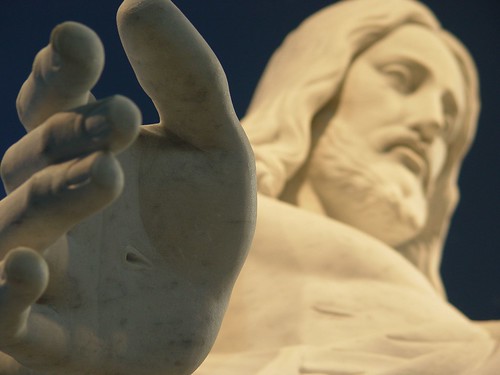
3. Jesus: Fact or Fiction? Part 1


We are going to examine Jesus' credentials here. There are several major questions that need answering:


1. Was the Biblical figure of Jesus an actual historical figure?


2. Was he actually the Son of God?


All of our lives hinge on the answers to these two questions.

If Jesus was a phony and all of Christianity is wrong, then we can either look into alternative religions seeking truth, or consign ourselves to godless atheism. If Jesus was not a phony and all of Christianity is right, then we have a major decision to make: will we follow him, or remain at a distance?

To answer the first question:

We have older documentation and earlier eye-witness accounts of Jesus' life than we have for any other religious leader of antiquity. There are many secular accounts of Jesus that confirm his historicity. Reliable sources like Cornelius Tacitus, Lucian of Samosata, Suetonius, Pliny the Younger, Thallus, Phlegon, Mara Bar-Serapion, and others, wrote of a man who claimed to be God and was killed for it. 

Unlike anyone else in history, Jesus fulfilled dozens of prophesies, including the location of His birth, key events of His ministry, and the circumstances of His death, all written centuries before He was born! To quote Josh McDowell "If you are not satisfied with 450 B.C. as the historic date for the completion of the Old Testament, take into consideration the following: The Septuagint--the Greek translation for the Hebrew Scriptures--was initiated in the reign of Ptolemy Philadelphus (285-246 B.C.)." In order to be translated, the scriptures had to be originally written at least 250 years before Jesus' birth!


It was prophesied that Jesus would be
     Born of the race of Abraham
     More specifically Abraham's son Isaac
     More specifically Isaac's son Jacob
     Of the tribe of Judah
     Of the family line of Jesse
     Of the house of David
     Born at Bethlehem
     Presented with gifts
     He would be filled with zeal for God
     His ministry would begin in Galilee
     Perform miracles
     Enter the temple
     Enter Jerusalem on a donkey


There are so many more, that gall and vinegar would be offered to him, that he would commit himself to God, that his bones would not be broken, that he would be pierced (all this on the cross). Could Jesus have engineered all of this himself? Methinks he could hardly have worked out the "born in Bethlehem" part, the manner of his death, or the soldiers' casting lots for his clothes (also specifically prophesied). Coincidence? It is estimated that the chance of one man fulfilling even eight of the prophesies Jesus fulfilled is 1 in 100,000,000,000,000,000. This is like painting a quarter red and then throwing it into a pile so large that it would cover the state of Texas two feet deep, and then asking a blind man to pick out the red quarter.


Come back for the next exciting installment!


Photo by midiman


LinkWithin

Related Posts with Thumbnails