Showing posts with label Books. Show all posts

Tuesday, July 31, 2012

How the World is Stealing Our Wonder

Airplane Window by contraption
Sometimes I wonder about my life. I lead a small life—well, valuable, but small—and sometimes I wonder, do I do it because I like it, or because I haven't been brave? So much of what I see reminds me of something I read in a book, when shouldn't it be the other way around? 
-You've Got Mail 
When I took my first-ever airplane trip, I expected to be amazed. I really thought that I would be knocked off my feet, thrilled, utterly flabbergasted by the completely unique experience of flying above the clouds, soaring so much higher than I'd ever been in my life. 


I buckled into my seat before takeoff, a bit apprehensive, then prepared myself for the roller-coaster feeling. It came, my stomach dropped, and we were in the air. When I looked out the window, the first word that came to mind was patchwork. The ground below looked like a patchwork quilt. And it immediately occurred to me how many times that word had been used in connection with flying. Books, magazines, movies, other people, they all describe the fields looking like patchwork.


This was the first disturbing thing. What followed was a few minutes of frustration as I tried to describe what I was seeing in completely original terms. It was hard. Every phrase that came to mind sounded hackneyed and cliche. The real shock was that even what I was seeing with my own eyes seemed not only familiar, but old. How many photos had I seen of the clouds? How many images of soaring wings? Dozens? Hundreds? It seemed so unfair that my first experience was almost spoiled because I had already experienced flying through blog posts, books, movies, etc. There was so little mystery, so little wonder.

Tuesday, June 19, 2012

Book Review: Too Small to Ignore

There are some books that hit you squarely between the eyes, revealing things you never knew and cannot imagine that you didn’t think of. What Dr. Wess Stafford lays out in his book, Too Small to Ignore, is a revolutionary approach to poverty and Christian missions that brought my attention to matters I had never considered before, and encouraged me in my own work as an advocate for children in poverty.

As the leader of Compassion International, Dr. Stafford has seen his share of poverty, but it all began when he was still a child growing up in an African village as the son of two missionaries. This is where he first learned about the ugliness of poverty and the beauty of the poor, and he has dedicated his life to saving the lives of others who might otherwise find their potential wrecked upon the hopelessness of poverty. Part memoir, part call to action, Too Small is a book meant to change your mind about children.

Friday, June 8, 2012

Book Review: Radical


“We are settling for a Christianity that revolves around catering to ourselves when the central message of Christianity is actually about abandoning ourselves.” 
― David Platt, Radical: Taking Back Your Faith from the American Dream


Poverty. Persecution. Suffering. Addiction. Darkness. These are things that consume our world, hold happiness in a stranglehold, and suck the life out of billions of people. This planet we call home is riddled with pain, and those of us who are blessed enough to be removed from such horrors as starvation, disease, and filth so easily ignore it all. It is so easy to sit inside our air conditioned houses on cushy couches and make grandiose plans about our futures.

I do not usually read books that I have never heard anything about, but when I saw a book titled Radical: Taking Back Your Faith From the American Dream, I had to check it out. What I found was a gripping, convicting, inspiring call to action that continues to fill my mind and heart with questions and controversies.

Wednesday, May 30, 2012

America, America.

What is an American? How does literature create conceptions of the American experience and American identity? I'm taking a course in American Literature right now, and this question keeps surfacing, popping up out of the textbooks and in our class discussion forums and in our videos and assigned reading. What is America? What do you think of when you think of that word? On the face of it, an American is just a citizen of the United States, but when we say that something is "American" we usually mean something different. 
    America by Cayusa
  • Apple pie and baseball
  • That star spangled banner
  • Democracy 
  • Capitalism
  • Technology 
  • Freedom
  • Individuality
  • Warfare
  • Opportunities
  • Melting pot
  • Pioneer spirit
  • Self-made man

Do any other words or phrases come to your mind? If you're thinking what I'm thinking, then it seems as if "America" is more of an ideal than a geographical location. After all, how many times have you heard something or someone who is certainly from America called "un-American?"

Literature has provided us with many ideas of what “American” means. It has preserved the oral traditions of the most ancient Native Americans, conveyed the revolutionary ideals of the United States’ founding fathers, and provided a vehicle for political, religious, and personal narratives that have both harmed and benefited the nation.Over the centuries literature has contributed to the concept of the "American" with cultural characters both fictional (e.g. Jay Gatsby and Tom Sawyer), and historical (e.g. Benjamin Franklin and the Puritans). These characters have come to stand for the best and worst of America, representing both heroes and villains. 

Thursday, May 10, 2012

Being True, Part 5: Hawthorne--The Author

This is the last segment of my essay about sin, hypocrisy, and guilt in Nathaniel Hawthorne's writings. Enjoy!


Hawthorne’s personal attitude toward sin and sinners is somewhat ambiguous, despite the existence of a deliberately intrusive narrator in nearly every one of his tales. Some call this issue the “Hawthorne Question”; literary critics want to know what the author of such darkly tragic tales could have thought about the worlds he was creating, but Hawthorne remains a riddle. Did the author sympathize with Hester Prynne? Was his moralizing narration meant to be genuine, or derisively ironic? Was he a Puritan at heart, or did he in fact despise the Puritans? Views on his moral and aesthetic beliefs often contradict one another. One author writes that “many of the central tenets of Transcendentalism (awareness of the creative and imaginative power of nature, the breaking away from form and tradition, and the emphasis on individual experience) can be seen in stories like “Young Goodman Brown” and novels such as The Scarlet Letter” (Felton), while another says “transcendentalism as such touched him not at all” (Canby 231). Advocates of Traditional Historicism, a school of literary criticism that takes social contexts and authorial intent into consideration, would search for answers among Hawthorne’s personal letters, in the politics of his day, and in the friends he made. Supporters of New Criticism would be more likely to take an intrinsic approach and search only between the two covers of an individual tale.

Tuesday, May 8, 2012

Being True, Part 4: The Architecture of Guilt

The fourth part of my essay on sin, guilt, and hypocrisy in Nathaniel Hawthorne's writings. It's more interesting than it sounds ;)


To say that Hawthorne’s writing shows a preoccupation with guilt would be an understatement. Most of Hawthorne’s most famous works are permeated with the tragedy of guilt, with a form of the word “guilt” appearing 35 times in The Scarlet Letter, 4 times in “Young Goodman Brown,” and as many as 12 times even in a novel with an uncharacteristically happy ending, The House of the Seven Gables. While some of Hawthorne’s characters choose to embrace sin and others hypocritically deny it, there is a third response: the sensation of guilt or responsibility for sin.

6233 House of Seven Gables - Salem, MA by lcm1863
6233 House of Seven Gables - Salem, MA, a photo by lcm1863 on Flickr.
The plot of The House of the Seven Gables focuses on the issue of guilt in both the past and the present. The novel begins with a history of the old Pyncheon family, a clan that is stained with the innocent blood of a man named Matthew Maule, who was executed in the Salem Witch Trials. The family patriarch, Colonel Pyncheon, had zealously cried out for Maule’s condemnation, and in a parallel to the biblical story of Naboth’s vineyard, Maule was killed on false charges and his beautiful piece of property snatched up by that same Colonel Pyncheon. The old Puritan did not have much opportunity to enjoy his ill-gotten gain, however, for Maule had cursed his accuser with the words “God will give him blood to drink,” and Colonel Pyncheon died a mysterious death in his newly built seven-gabled mansion.

Sunday, May 6, 2012

Being True, Part 3: Whited Sepulchers--Hypocrisy

The third part of my essay on sin, guilt, and hypocrisy in Nathaniel Hawthorne's writings...enjoy!


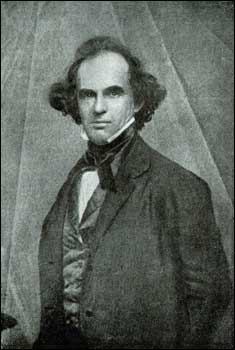
File:Nathaniel Hawthorne by Whipple c1848.jpg
Hawthorne’s writing consistently lifts a light to illuminate our souls, and in several of his stories we are forced to come face to face with hypocrisy—the false pretense of goodness which disguises inner evil. From the religious excesses of the Puritans to the blind optimism of the Transcendentalists, Hawthorne saw hypocrisy all around him. The result of his observations is one of Hawthorne’s darkest and most disturbing tales.
In his short story “Young Goodman Brown,” Hawthorne introduces the reader to the title character, a seemingly harmless young man, and his pretty little wife, Faith, who seems to be an allegory for all that is pure and good. One evening Goodman Brown hurries away to the forest on a mysterious errand, against Faith’s wishes, and we soon learn that he is going to a “Black Mass” in the forest. He has the best of intentions for the future, determining that “after this one night” he would return to Faith and “cling to her skirts and follow her to heaven” (9), but as the night progresses he realizes that evil is more powerful than he had  imagined. As he travels along the forest road he discovers that “everyone he has ever respected is actually a vile creature in the service of Hell” (Rogers 4); he even hears the voice of Faith among the sinners, and realizes that virtue is but a dream and “evil is the nature of mankind” (Hawthorne, “Young Goodman” 31). After this terrifying revelation, Goodman Brown and Faith are about to be baptized by the devil when Brown suddenly finds himself alone in the forest in the morning. It is possible that the entire episode was a dream, but Brown’s faith in humanity has been permanently scarred and forever afterward he shrinks away from the hypocrisy of his neighbors“Young Goodman Brown” could be seen as Hawthorne’s indictment of Puritanical hypocrisy; on the other hand, it might be seen as “everyman’s response to the darkness that lives in every human” (Howard).
gavel  by s_falkow
gavel , a photo by s_falkow on Flickr.

Two hypocrites figure prominently in Hawthorne’s fiction.

Wednesday, May 2, 2012

Being True, Part 1: Hawthorne--The Man

I just finished semester 2 out of 4 at Thomas Edison State College! I spent a ton of time writing a final paper for my American Literature I course (it got a grade of 100%!), and thought that I would share it with you lovely readers :) 

Perhaps you love Nathaniel Hawthorne, perhaps you loathe him, perhaps you've never heard of him. He was a fascinating man, a great author, and I'm an ardent admirer of his work (read: "big fan"). This paper is rather long, so I'm posting it in several parts. Hopefully you'll read it and gain a new appreciation for the mystery, beauty, and depth of Hawthorne's classic literature!


Being True: Sin, Guilt, and Hypocrisy in Hawthorne’s Writings

File:Nathaniel Hawthorne by Brady, 1860-65.jpgNathaniel Hawthorne was an American author who could be described as a dark romantic, an examiner of the human soul, a master of Gothic literature, or simply a pessimist. At a time in history when American writers were discovering their own potential, finding God in nature, extolling the pioneer spirit, and anticipating a golden age for the United States, Hawthorne was a voice calling out in the wilderness, reminding the world of the darker elements beneath it. In his classic novel The Scarlet Letter, Hawthorne states  that the “founders of a new colony, whatever Utopia of human virtue and happiness they might originally project, have invariably recognized it among their earliest practical necessities to allot a portion of the virgin soil as a cemetery, and another portion as the site of a prison” (Scarlet Letter 20). Hawthorne seemed to be reminding Americans of something they would like to forget: sin, like death, is an inevitable part of the human experience. Hawthorne wrote more than 80 novels and short stories, and many analyze the legacy of America’s Puritan fathers and delve deeply into Hawthorne’s own beliefs about sin, hypocrisy, guilt and the truth. Two of his novels, The Scarlet Letter, and The House of the Seven Gables, as well as the short story “Young Goodman Brown” deal with these key issues, and by studying the author and sociohistorical context  of these works, as well as their major themes and intimate details, one gains a unique perspective on the subjects which weighed upon Hawthorne’s mind. His consciousness of sin and the need for truth became a major element of American Gothic literature, and continues to influence authors and readers today.

Monday, March 26, 2012

Letters from an American Student

spotting by mezoneI dashed off this semi-satirical rant (for lack of a better word) for a college assignment, "Imagine that you have been asked to compose a series of Letters from an American Student. Write a letter to your foreign correspondent in which you address the question, 'What is an American?'." It's inspired by J. Hector St. John de CrèvecÅ“ur's Letters from an American Farmer: Describing Certain Provincial Situations, Manners, and Customs, Not Generally Known; and Conveying Some Idea of the Late and Present Interior Circumstances of the British Colonies of North America, 1782. My work is considerably shorter that his.


Letters from an American Student
What is an American?


The position of a student in America, which I happily occupy, is one of the most enviable in the world, obtained by millions and sought by millions more. It is the status of one who is not required to toil for one’s bread, or even to pay one’s own way (as government assistance and copious loans are generally available). It is an honored status which might derive its dignity from the tradition of scholarly achievement which has furthered the ambitions of generations of Americans (and it is imbued with a certain nebulous respect by the general populous),  but for many students of higher learning, academics have very little to do with college life—socialization and an expansion of knowledge concerning local “hangouts” is more the order of the day. Of course there may be one truly studious student in a hundred, one who is dedicated to furthering his or her intelligence and using a diploma for purposes of gainful employment in the future, but for each one of these there are many more of us who are perfectly happy to study Piaget’s theories of child development, Freud’s outdated notions of psychotherapy, and to debate the relative virtues of radical communism and socialism rather than attempt to actually learn anything of practical use.

Friday, March 9, 2012

Exchanging Burdens


  1. Plan my day
  2. Put in new contacts
  3. Exercise
  4. Read books
  5. Write Altogether Separate Post
  6. Practice Piano
  7. Write Granny
  8. Call Brent
  9. Work on college essay
  10. Write for Picture Britain
  11. Email Jonathan
  12. Write Church newsletter
  13. Journal
  14. Type notes
  15. Come up with ideas for guest posts
  16. Go to work for eight hours

This is the kind of to-do list that's been weighing on my chest for the past few weeks, etching lines in my forehead, weighing my steps, tying me to my pillow, stiffening my muscles and eating at my bones. When Solomon said, "anxiety weighs down the heart," he wasn't kidding. I don't have enough time. There's so much to do. People are counting on me!

You probably know that I'm in the middle of reading One Thousand Gifts by Ann Voskamp right now, and it's been challenging me to trust God on a wholly different level. I'm learning that I have to do more than trust Him with my salvationI must trust Him with the smallest items on every day's to-do list. Do you sometimes make that error too? Will you trust the Lord with your immortal soul but not with your schoolwork or job interview or lunch? "Therefore I tell you, do not worry about your life...." How easy that sounds, and yet so hard. 

Sunday, February 26, 2012

Book Giveaway!

Calling all Christian homeschool girls!

If you haven't checked out www.AltogetherSeparate.com, this is a great time because we're running a lovely giveaway of that book I've been telling you all so much about.


One Thousand Gifts is a New York Times Bestselling book written by Ann Voskamp. Its purpose? Daring you to live fully right where you are by giving thanks in all things. It's something that every Christian should be doing, but how often do we forget to be filled with the joy of the Lord?
“I want to see beauty. In the ugly, in the sink, in the suffering, in the daily, in all the days before I die, the moments before I sleep.”
Ann is really a poet masquerading as a prose-writer. Her words sing off the page as she carries the reader through a journey from brokenness to absolute joy! Ann's search for beauty is not the result of a perfect life that's brought her breakfast in bed from the day she was born; it's a search that was bled out of a horrific wound—many wounds—some that I can't imagine, and some that I can identify with perfectly.  

Her challenge to herself was to find 1,000 gifts in the world around her. They weren't the kind of gifts that we usually thank God for, they were bubbles, and warm sunlight, and weathered wood, and the curl of a child's hair, and her little boy's injured hand, and tulips in a bucket with wooden candlesticks, and her scarred past, and a white fleece shirt, and what the scale read. Ann says, “How my eyes see, perspective, is my key to enter into His gates. I can only do so with thanksgiving. If my inner eye has God seeping up through all things, then can't I give thanks for anything? And if I can give thanks for the good things, the hard things, the absolute everything, I can enter the gates to glory. Living in His presence is fullness of joyand seeing shows the way in.” This book is where Ann shows us the key to entering those gates to glory.

I know that this is a powerful book, even though I have yet to finish reading it myself. I joined Ann on her quest to find 1,000 gifts in a year (read some of my gifts here), and it's changing the way I see the world.

So, about that giveaway. If you want to be part of this amazing gift-counting experience, then join the community over at Altogether Separate!


Friday, February 24, 2012

More Gifts

  • Wind is the breath of sunshine
  • The whistling train is victorious, chugging and squealing onward and upward
  • My pillow is the transport to a world without expectations or responsibilities 
  • From Grace for the Good Girl, "You are not accepted because you are good. You are free to be good because you are accepted."
  • My hard-working-mud-caked-blue-jean brother
  • Creative fingers, held in anticipation over keys of black and white
  • Interactions with blog readers
  • Arriving to piano lessons early, sipping hot black coffee
  • Hearing words of inspiration and encouragement while wiping spaces clean 
  • Mom and Dad, laughing together on the porch
  • Aaron and his buddies laughing as they spill sawdust over the garage
  • My parents taking it easy after I banged up the car
  • "By perseverance the snail reached the ark." -C.H. Spurgeon
  • "On every level of life, from housework to heights of prayer, in all judgment and efforts to get things done, hurry and impatience are sure marks of the amateur." - Evelyn Underhill
  • Kyla's hilarious, wonderful review post: www.altogetherseparate.com
  • Napkins in symmetrical rows, fresh in their pink elegance
  • Cinnamon-ed muffins fluffing in the oven
  • A spider folded, dangling underneath a table; repulsive then fascinating  
  • Fuzzy blanket, lovingly stitched
  • The littlest nails in the finished Axis and Allies game board
  • The complex melodies and rhythms of classical music
  • The frosting, chapping air to remind you that you're alive
  • Rocks and dirt, turning with the flip of a shovel and a muddy converse shoe
  • The incredible intricacy of snowdrops
  • Adorable Russian doll earbuds
  • Scrumptious strawberries in thick chocolate ice cream
  • Cute little mini cooper
  • Broken lips praising the Lord
  • My tea tidy, glued with love
  • A knitted scarf, a white elephant gift, and a wrinkled book from Goodwill
  • Gelatinous halwa, glossy and sweet
  • Blue jays hopping and diving and nibbling
  • Burst of sunlight through lowering clouds
  • After-midnight laughter over party plans
  • Mamage laughing at my lame joke
  • Late night laughs with the backseat comedians
  • Nibbling--cook's privilege
  • Guests having a blast at a party we created
  • The opportunity to hear college lectures while cleaning
  • Mr Byron, growing old alone in his house
  • The possibility of a tumor on Malachi's brain
  • Another hard night of cleaning
  • Blazing orange coals, simmering in the stove
  • Rows of colorful, beautiful, comfortable clothes
  • A man and his dog, lounging warm in the office
  • I can hear my loving, happy family around me
  • The assurance of God's approval through Christ
  • Knowing that God is listening to every word I pray
DSC_1784

Thursday, January 19, 2012

One Thousand Gifts

How thankful are you? No, really. How many times do you purposefully put a stop to whatever you're doing and give thanks for the beautiful things in your life, or even just pause a moment to take in the joy of everything that is around you? I know that I've been unforgivably ungrateful for far too long, and 2012 is the time to change that. 

Enter Ann Voskamp. She's an amazing woman who has written the New York Times Bestselling book One Thousand Gifts (she also blogs over at www.aholyexperience.com), which is "a dare to live fully right where you are." It's a book about the gifts that God gives us every day--too many to count--but she's trying to count some (1,000 per year, to be exact), and she's got a few thousand people doing it with her. I'm doing it too. 

She has recommendations for what to look for every day (download her creative ideas here), and if you follow her plan you're going to "collect" 1,000 gifts in a year's time. I got started late, but I've committed to writing down the gifts I'm given on a daily basis. Here's what I have so far:


Three things about myself that I'm grateful for: I have a great metabolism. I can spell very well. I can write creatively.


Something inside: My ginormous window seat. Something outside: Horses frolicking in the pasture. Something on a plate: A very creative meal when there was no food in the house

Lines I Overheard That Were Graces: "I love you, Abby." -Aaron; "Thank God for work." -Rod


A gift in my hand: Mrs. Joyce's camera. A gift I walked by: This apple pie. A gift I sat with: My laptop

Something sour: a bright orange tangerine that pops with flavor on my tongue. Something sweet: a conversation with Mr. Byron. Something Just. Right.: A bright green pine tree drooping over the road, covered in pine cones


Thursday, November 24, 2011

100 Reasons I Give Thanks

  1. I have a merciful Savior who loves me, warts and all.
  2. The leaves change color in the fall; they don’t have to, but they do.
  3. My mother is a creative person who “gets” me on so many levels and who loves me to death.
  4. My father is a humorous and loving man who provides well for our family and would do anything for us.
  5. My little brother may be a twerp sometimes, but he’s my twerp and I know that he loves me…deep down.
  6. I have a part-time job with my family that allows me to make a regular paycheck and have plenty of time to listen to books on my iPod.
  7. I am incredibly blessed to have so much extended family living nearby; my grandparents are amazing.
  8. Foggy mornings.
  9. While I may not have many friendships, the ones I have are deep and full of meaning, purpose, beauty, and laughter.
  10. I am in on the Goodwill Secret—and am not afraid to utilize my knowledge.
  11.  I have the freedom to experiment, to explore, to create a future that’s perfectly suited to me.
  12.  I have access to an awesome public library filled with thousands and thousands of books, DVDs, and audio CDs.
  13.  My country grants me freedom of religion, and I need have no fear to worship.
  14.  I am physically fit, capable of doing everything I want to do.
  15.  There are Panini sandwiches and gallons of pesto in the world.
  16.  I have been able to pursue a non-traditional education through homeschooling, CLEP and DSST tests, and online college.
  17.  Despite the fact that my body does not like my fingers and frequently attempts to sever them, I have never been seriously injured.

Wednesday, November 9, 2011

Heart of Darkness

One of the classes I'm taking is called Nonwestern World Literature, and it examines the relations between the cultures of the West and non-West through the literature of both sides. My first graded assignment was to write a post for the class discussion board comparing and contrasting my experiences with cultures other than my own with the adventures described in Joseph Conrad’s Heart of Darkness. I've reproduced my work here for your insight and comments, you can read a short summary of Darkness here.

My own experiences with other cultures show little similarity with the adventures described in Heart Of Darkness, but upon comparing myself with the characters in Joseph Conrad’s novel, I find striking similarities in my reactions to a different culture living in my own community.

Unlike Marlow, I have never been immersed in a Nonwestern country, but where I live you don’t have to cross the border to have experiences with other cultures. I am exposed on an almost daily basis to the world of Hispanic immigrants, whose language, customs, appearance, and ethnic heritage are so different from my own that it is hard to see any common ground between us. There is a temptation to see these people as “foreigners”, no matter how long they’ve lived in America, and their nationality seems to set them apart from the rest of us. In an all-too-human way, this separation can cause us “locals” to feel somewhat superior to the relative newcomers.

This reaction echoes what Marlow said about foreigners being “veiled…by a slightly disdainful ignorance” to Western eyes. The classic reaction of Western civilization to the “exotic” and unfamiliar seems to have been contempt, stemming from an outrageous sense of pride. My own reaction to my Hispanic neighbors is somewhat similar to Marlow’s own—they seem set apart, different, simply “other.” I certainly don’t hate or resent them, but I’m not taking pains to interact with them either. This is where Conrad gives us a great warning: a tiny seed of disdainful ignorance can grow into racial hatred, even insanity.

There is danger in the moment we define ourselves as “us” and “them”. I may live my life on a separate plane from my Hispanic neighbors, without many activities or experiences in common, but the moment I imagine that they are on a lower plane, or even one that is very different from my own, that is when the darkness Conrad warned against can take hold. When I look inside myself and back at someone else who is part of another culture, I can see that their hopes, dreams, loves, strengths, and weaknesses deserve every bit as much respect as mine, and they demand not my pity but my understanding. In Heart Of Darkness, Conrad wrote about what can happen—what has happened—when a root of disdain spawns the brutalization of an entire continent.


Tuesday, October 4, 2011

My Bucket List In Progress


A couple months ago I wrote a post about bucket lists, where I wrote about lifelong goals, living to the fullest, the magic of thinking big, etc. Well, I have since created a list of my own. 

In case you're not familiar with Heritage Makers, it's an awesome online program that gives you the ability to create gorgeous custom storybooks, calendars, canvas prints, greeting cards, invitations, and even personalized playing cards (watch the video introduction here). I used HM to create a 14x11 poster of my bucket list (see the image above) to frame and hang on the wall above my bed as a reminder of my goals.

I call this my "Bucket List in Progress" because it is by no means a concrete thing. I've listed such goals as "write a textbook" and "own a Cavalier King Charles Spaniel" that I may not want to do someday for a myriad of reasons. But this is an outline, a rough sketch, something to aim for. I intend to alter it every few years to accommodate new goals and cross out the ones I've already accomplished, honing it to a razor-sharp edge of intention. 

So without further ado I present to you my current bucket list, with goals listed in no particular order: 

The old streets of Saltaire Village, a photo by Paul Stevenson on Flickr.

1.       Keep it simple
2.       Stay under 130 lbs.
3.       Deep relationships
4.       Create a self-study program for lifelong learning
5.       Find or create work that I love
6.       Live in England
7.       Make a friend in every European country
8.       Fall in love
9.       Discover my reasons for living
10.   Work for myself
11.   Get good at tennis
12.   Ride a horse “in the rough”
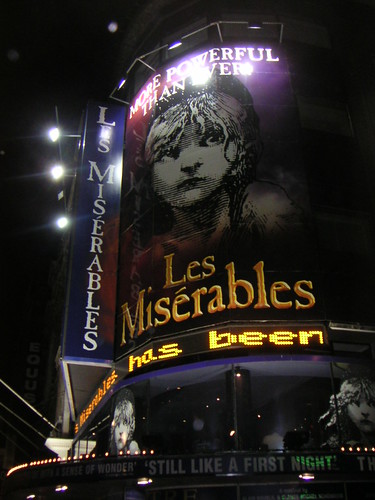
Les Miserables West End, a photo by mart wegman on Flickr.
13.   Learn another language
14.   See a show on Broadway/the West End
15.   Learn to dance
Grayson.., a photo by Bruce Tuten on Flickr.
16.   Scuba dive in a coral reef
17.   Sleep in a British castle
18.   Own a Cavalier King Charles Spaniel
19.   Spread the Gospel
20.   Always tithe at least 10%
21.   Become influential in a godly ministry
It is Finished, a photo by abcdz2000 on Flickr.
22.   See the Northern Lights
23.   Visit
        The British Museum
        The Uffizi Gallery
        The Smithsonian
        The Louvre
24.   Live at least six months in a foreign country
25.   Tour New England
26.   Live in my “dream cottage” (a white cottage on a New England beach)
27.   Create a lovely garden
cutting loose, a photo by SqueakyMarmot on Flickr.
28.   Become a semi-professional photographer
29.   Become a connoisseur
30.   Read the complete works of Shakespeare
31.   Discover my strengths, weaknesses, passions, and gifts
32.   Never take on a lifestyle of debt
33.   Be a major influence in a child’s life
34.   Prison ministry
35.   Become an expert
36.   Win a prestigious blog award
37.   Write a textbook or study guide
Flags!, a photo by Paul Kehrer on Flickr.
38.   Be a New York Times bestselling author
39.   Go to a Green Bay Packer Game
40.   Make mistakes
41.   Learn to not take offense


And what is your personal opinion of these goals? Do you have a bucket list of your own? Are you willing to post it for the world to see?

Sunday, September 11, 2011

Reading: Who Will You Become?


Notturno by gualtiero

They say that you will be the same person in five years as you are today except for the people you meet and the books you read. It can be (but is not necessarily) difficult to determine which people you will meet. It is, however, the matter of a few mouse clicks to determine exactly which books you will read in the coming days, months, and years. There are millions of books are at your fingertips thanks to sites like Amazon.com, and you haven't an excuse in the world not to buy, beg, borrow, or steal something that could possibly revolutionize your life for the better. 

Anne Lamott, author of such works as Bird by Bird and Traveling Mercies, said that her life was changed by The Only Dance There Is by Ram Dass. U.S. Senator John McCain says that Ernest Hemingway's For Whom The Bell Tolls "seized (his) attention." World-famous career coach Dan Miller credits Earl Nightingale's book The Strangest Secret as giving him the vision to go beyond his family's Mennonite farm to pursue an amazing life. 

Which books will you read before the end of the year?  

If you look at the next five books on your reading list, you will find an uncannily accurate foretelling of the kind of person you will soon be. If you don't have a reading list, the same holds true.

Who might I be after reading these books?
  1. A Million Miles in a Thousand Years by Donald Miller = a better Christian
  2. Notes From a Small Island by Bill Bryson = a better Anglophile
  3. Crime and Punishment by Fyodor Dostoevsky = someone with a better understanding of social alienation, Nihilism, and the idea of the superman
  4. Crush It! by Gary Vaynerchuk = a social-media-savvy girl who cashes in on her passion
  5. On Writing by Stephen King = a better writer


Read about The Book That Changed My Life at Suite101.
Notturno, a photo by gualtiero on Flickr.

LinkWithin

Related Posts with Thumbnails